Evaporative Cooling and Sensible Heat Recovery Enable Practical Waste-Heat Driven Water Purification
Abstract
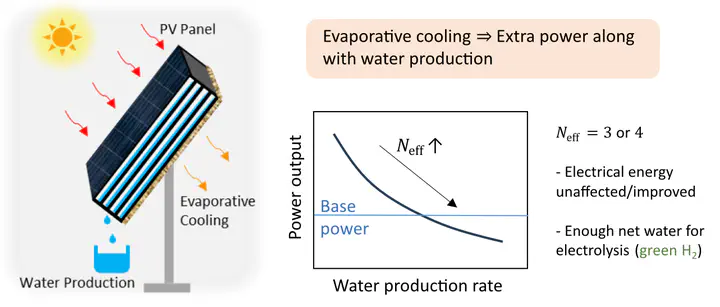
Waste heat capture from systems such as photovoltaics (PV) and refrigerators can lower their energy efficiency by increasing their operating temperature. In this study, we evaluate the potential of final-effect evaporative cooling and internal heat recovery in a multi-effect diffusion distillation (MEDD) to produce pure water without negatively impacting the energy efficiency of the waste-heat source. Lab-scale experimental results from a multi-effect membrane distillation module validate the concept, showing that water production can be enhanced by $>$20~% while simultaneously pulling down the module’s operating temperature. A detailed numerical model of a solar-MEDD is implemented and validated. The incorporation of sensible heat recovery and evaporative cooling increase pure water production by approximately 10~% each. Although the pure water production of a standalone MEDD increases with increasing effects N, when coupled to a solar PV module, increasing N also decreases PV electricity production. Therefore, a PV-MEDD with fewer effects ($łeq$4) is preferable and such a system can produce sufficient water for electrolysis (green H2 production) while maintaining or improving PV electrical energy production throughout the year under varying climatic conditions.
Add the full text or supplementary notes for the publication here using Markdown formatting.